




The “Nextpoint eDiscovery Landscape” survey reveals a resource gap at the heart of modern litigation practice, highlighting the biggest ediscovery challenges in 2026.
Practicing law has always had high demands for the people who do it. Long hours, high stakes, and work that resists shortcuts. But in ediscovery in 2026, there’s a new layer of pressure bearing down on legal professionals at every level: The data keeps growing, and the resources to manage it aren’t keeping up.
That’s the central finding from our latest “Nextpoint eDiscovery Landscape” survey, and it showed up across nearly every question we asked. Legal professionals have more information to review. Less time to review it. Tighter budgets. Fewer tools. The gap between the work that needs to be done and the capacity to do it is widening, and legal teams are feeling it.
Here’s what 101 legal professionals told us.
How we did it
Before diving into the findings, let’s take a quick look at who responded. The majority of our respondents (about 70%) work at law firms or legal services organizations, with the remaining (30%) spread across corporate legal departments, government agencies, legal software companies, and consultancies. Firm sizes were well distributed, ranging from solo practices and boutique firms (1–9 employees) to large organizations with more than 200.
We asked respondents to identify their three biggest firm-level challenges in ediscovery, their biggest individual challenges, and their top professional priorities. What came back painted a consistent picture that cuts across job titles, firm sizes, and practice areas.
The firm-level challenge everyone shares
Ask 101 legal professionals what their firm struggles with most in ediscovery, and you’ll get a lot of different answers. But one rises to the top by a wide margin.
Document management, review, and reduction was cited by 58% of respondents as one of their firm’s biggest challenges, making it the single most common answer in the entire survey. Data collection came in second at 34%, followed by working with clients for collections (31%) and chronology and timeline building (28%).
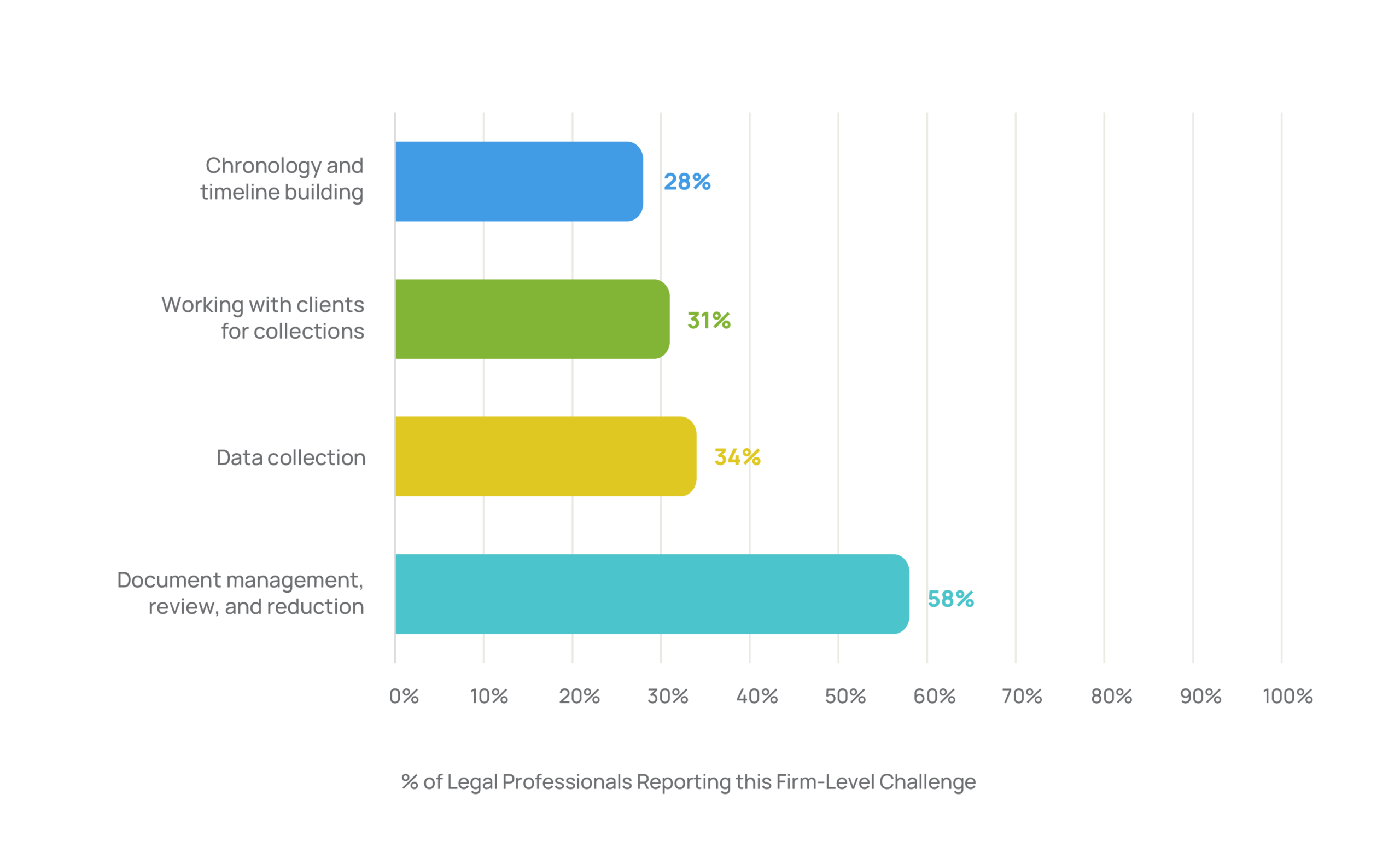
The dominance of document management isn’t surprising when you consider the sheer volume of electronically stored information legal teams are expected to process. Email threads, text messages, cloud storage, collaboration tools — the sources keep multiplying, and the documents keep piling up. Reducing that volume to something reviewable remains one of the hardest problems in the business.
Some respondents put it plainly:
“We are often collecting a large number of documents from numerous sources. Gathering those documents, organizing them, and producing them can be a challenging process.” — Attorney at a mid-size law firm
“We have no document reviewers so I end up reviewing all offensive and defensive discovery documents myself.” — Assistant Attorney General at a government agency
What’s notable is how universal this challenge is. It showed up at similar rates across attorneys (59%) and paralegals (61%), across small firms and large ones, across practice areas from litigation to corporate law to criminal defense. If there’s one thing the legal industry agrees on, it’s that document management is a problem that hasn’t been solved.
★ Want to go deeper?
Our new guide features expert-recommended solutions to the biggest challenges identified in this research, along with direct insights from survey respondents about what’s working (and what isn’t) in practices like yours. Download the guide to read more about these challenges and the practical approaches legal professionals are turning to.
The personal squeeze: Time, budget, and resources
While document management dominated firm-level challenges, the picture of what’s holding individual professionals back tells a slightly different — and in some ways more urgent — story.
When we asked respondents to name their biggest individual professional challenges, the top three answers were:
- Lack of time: 41%
- Budget limitations: 32%
- Lack of resources or technology: 26%

Read those three together and a clear pattern emerges. Legal professionals aren’t just dealing with a document problem, but a resource problem as well. The volume of work has grown, but the time, money, and tools available to handle it haven’t grown with it.
The open-ended responses made this tension concrete. One attorney described the downstream effect of resource constraints bluntly:
“Spending attorney time on clerical functions.”
Another described a technology experience that compounds the problem:
“Seems like nothing is ever intuitive in how you think it would work. So every time I have to use an ediscovery platform, it’s like learning all over again.”
These pressures don’t exist in isolation. A team with a limited budget is also likely to be under-resourced on technology. A team without the right technology spends more time on manual tasks. And a team drowning in manual tasks is the same team that said “lack of time” is their biggest individual challenge. They compound each other — and together they describe something more fundamental than any single pain point: a gap between what ediscovery demands and what most legal professionals have to work with.
What this means for legal teams
The through-line across all of these findings is resource pressure. The firms best positioned to close the document management gap are the ones that can free up time, stretch their budgets further, and put the right tools in the right hands. That’s not a new idea, but this survey puts real numbers behind just how acute the pressure has become.
If you’re navigating these challenges in your own practice, you’re not alone. Over 100 legal professionals just told us the same thing, and our ediscovery experts have recommendations for each of the pain points identified in this survey.
Our new guide shares 21 tips to navigate the challenges highlighted in this research, with expert-recommended solutions and direct insights from survey respondents. Download the guide to learn how to solve the challenges that are holding your practice back.