

Point solutions vs. unified platforms: How legal teams manage large ediscovery datasets
A practical comparison of stitched-together tools and single-system platforms — and what each approach actually costs a case


Every legal team managing a large case eventually hits the same fork: keep adding specialized tools for collection, processing, review, and case building, or move everything onto one platform. It's not a hypothetical choice — it shows up in every budget, every deadline, and every moment a document has to move from one system to another. This guide breaks down what point-solution sprawl actually costs, what a unified platform changes, and how to evaluate which approach fits your caseload.
How do legal teams manage large datasets with ediscovery software?
Modern ediscovery datasets rarely come from one place. Evidence arrives from email servers, Slack and Teams channels, mobile devices, cloud storage, and deposition transcripts or video — often all in the same case. Some legal teams handle that volume by stitching together a lineup of specialized tools, each covering one piece of the puzzle. Others run the entire lifecycle on a single platform built to hold it all. The approach a team chooses affects far more than convenience — it determines how much time and money is spent moving data between systems instead of working the case.
What is point-solution sprawl in ediscovery?
Point-solution sprawl happens when a legal team relies on separate, specialized ediscovery tools for each stage of the process — one for uploading and organizing collected data, another for document review, another for deposition management, another for trial prep, and often another for courtroom presentation. Each tool has its own login, its own billing structure, and its own data format. Moving a case forward means exporting from one system and importing into the next, which means paying to move your own data, risking the loss of coding, redactions, and annotations at every handoff, and creating a new point of exposure each time client data leaves one system and travels to another.
What is a unified ediscovery platform?
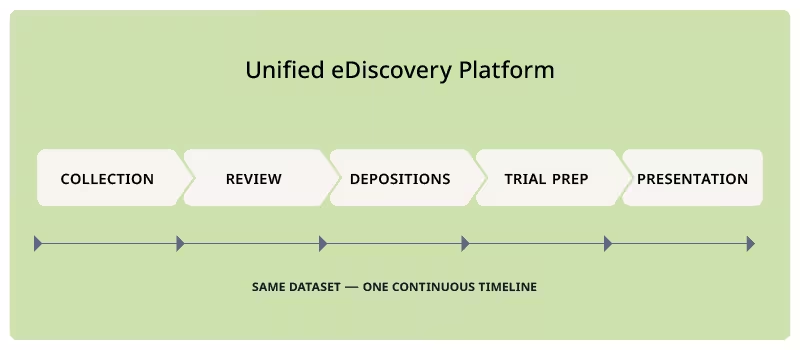
A unified platform combines data intake and processing, document review software, deposition management, trial prep, and courtroom presentation in one environment, under one login, on one bill. Evidence uploaded during discovery stays in place as the case moves forward — the same document that's reviewed and coded becomes an exhibit later, without a separate export step. Deposition designations link directly to the documents referenced in them. There's no handoff between systems, because there's only one system.
Point solutions vs. unified platforms: workflow and cost differences
How does point-solution sprawl affect case timelines and cost?
Consider a mid-size case with a few hundred thousand documents. Data is uploaded into one tool, imported into a second for review, tracked in a third for depositions, rebuilt in a fourth for trial prep, and reformatted again for a fifth tool used in courtroom presentation. Each transition requires reformatting files, re-establishing coding panels, and manually reconciling what was flagged in the previous system. A paralegal who spent a week building a privilege log in the review tool has to recreate — or carefully re-import — that work before it's usable in the trial-prep tool. Multiply that across every stage, and the case timeline absorbs weeks of work that never touches the actual legal analysis.
Beyond the lost time, each handoff is also a security event. When files leave one vendor’s system and arrive at another’s, privileged or confidential material is in transit — over email, FTP, or shared drives — multiple times over the life of a case. A misdirected export or a gap in a smaller vendor's security practices can expose the material a legal team is obligated to protect. Every added tool is another party with access to client data, and another point where that data can be lost or leaked.
How does a unified platform change that same workflow?
Run the same case on a single platform, and the sequence looks different. Data is uploaded and organized in place. Review happens on the same documents, with coding and redactions saved permanently. When it's time to prepare for depositions, trial, or courtroom presentation, the same documents — with the same tags, privilege calls, and annotations — are already there. There's no export, no reformatting, and no reconciliation step, because nothing ever left the system.

When does a point-solution approach still make sense?
A unified platform isn't the right call for every situation. A team with one narrow, specialized need — a single forensic collection from a hard-to-reach device, for example, or a one-off technical analysis — may be better served by a specialized tool for that specific job rather than a full platform. Point solutions make the most sense when the need is truly isolated and won't need to connect to the rest of the case.
What should legal teams evaluate when comparing platforms?
A few questions cut through most of the noise:
- Is pricing per-user or per-gigabyte, and how does that scale as the case grows?
- Does the platform's document review software connect directly to trial prep, or does data require a separate export?
- Does the vendor offer legal services support — consulting, managed review, trial prep — when the team needs expert hands, not just software?
- How many times, and to how many separate vendors, will client data have to travel over the life of a case?
- And what does the total cost look like across the full life of a case, not just the sticker price of any one tool?
How Nextpoint runs ediscovery on one platform
Nextpoint runs ediscovery and case building on one platform, with predictable per-user pricing and no data hosting charges — cost doesn't climb as case volume grows. Evidence uploaded for discovery stays available through review, depositions, trial prep, and courtroom presentation, without export steps in between. Because evidence never leaves the platform between stages, client data isn't repeatedly exported to or shared with outside vendors — reducing the number of places it could be lost, mishandled, or exposed. For teams that need more than software, expert legal services are available directly — strategic ediscovery consulting, managed review, and trial preparation support, scaled up or down as the caseload demands.
Ready for a unified ediscovery platform?
Get a personalized walkthrough of how Nextpoint streamlines every stage of your case — from document review to deposition prep to trial presentation.
Frequently asked questions
Does switching from point solutions to a unified platform require data migration?
Yes, typically a one-time migration when moving existing cases onto a new platform. Ongoing cases benefit immediately, since future data doesn't require repeated exports between systems.
{{enterprise-ediscovery-data-migration}}
Is a unified platform more expensive than separate tools?
Not usually, once the full cost is measured. Point solutions often look cheaper per tool but add up through data charges, per-tool licensing, and the staff time spent reconciling data between systems. Per-user pricing with no hosting charges tends to be more predictable as a case grows.
Can a unified platform handle the same range of file types as specialized tools?
Most unified platforms are built to accept the same broad range of file types — native files, forensic images, PST files, and cloud exports — as individual point solutions, since they're designed to serve as the single point of intake for a case.
Do small legal teams benefit from a unified platform, or is it mainly for large caseloads?
Smaller and mid-size teams often see the biggest relative benefit, since a single system reduces the training, coordination, and administrative overhead that a lean staff would otherwise have to absorb across multiple tools.
Join our Nextpoint newsletter list
Related Resources
Blog

Blog
Nine questions to ask potential vendors on pricing, data security, support, and AI before you sign.

Blog

Blog
Discover how trial prep software and trial presentation tools can help you build and deliver a winning argument.
Blog

Blog
Discover how ediscovery metadata can make or break a case, with iPhone photos, timestamps, and GPS data serving as verifiable evidence.
Case Study
Case Study
Midsize defense firm increases software adoption by 20% with Nextpoint
Experience Nextpoint for yourself
Learn how our transparent pricing and powerful platform help legal teams streamline litigation from discovery to decision.