

Stop reinventing the wheel: A better approach to mass tort case management
Mass tort case management is more than organizing documents — it's about building institutional knowledge that compounds across every matter.


MASS TORT SERIES // Part 1 of 4
Mass tort litigation is, by nature, repetitive work. A firm handling a new opioid case today will often face the same medical literature, expert witnesses, and opposing counsel they encountered in opioid litigation last year. The documents change, the plaintiffs change, but the underlying infrastructure of the case looks remarkably familiar.
Yet most firms build that infrastructure from scratch every time.
They re-upload the same medical studies. They re-import transcripts of experts they've already deposed on similar issues. They start a new matter with no institutional memory of the last one, not because that knowledge doesn't exist, but because the tools they're using weren't built to carry it forward.
In an era where mass tort practices are managing hundreds of cases simultaneously across multiple jurisdictions — and where most platforms charge by the gigabyte — that redundancy becomes inefficient and expensive.
The case for master repositories
Gaining a competitive edge in mass tort doesn’t necessarily require more resources. Treating every closed matter as an asset is an invaluable strategy.
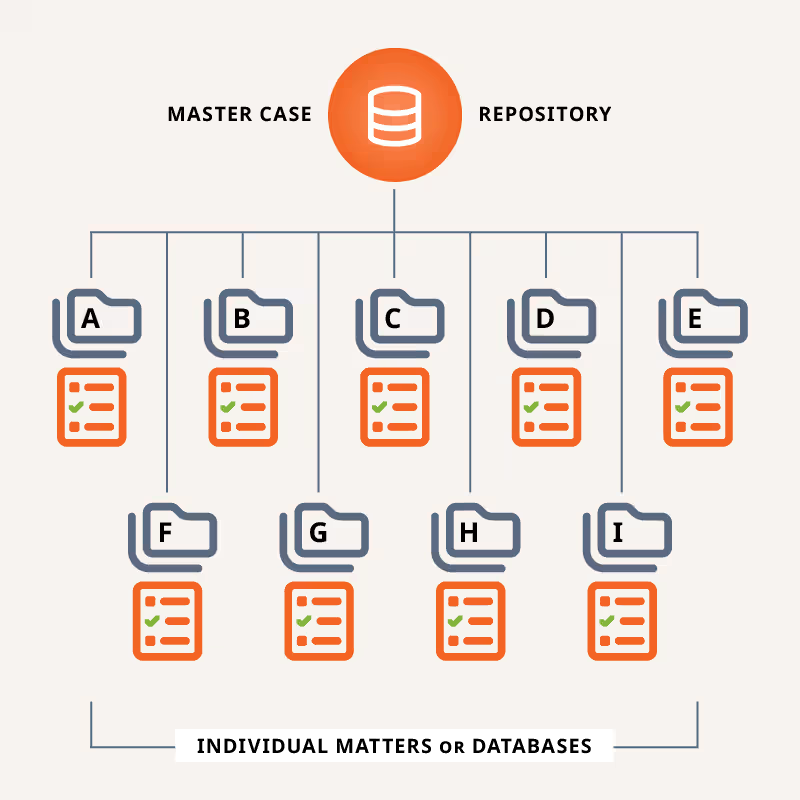
That starts with building master repositories: centralized libraries of materials that appear repeatedly across cases. Medical literature is the obvious starting point. In pharmaceutical mass tort, the same clinical studies, FDA correspondence, and scientific literature surface again and again across individual plaintiff matters. Housing these in a single searchable repository, rather than re-collecting and re-hosting it for each new case, means your team spends time analyzing documents rather than hunting for them.
The same logic applies to deposition transcripts. If your firm has deposed a particular expert witness on a related matter, that transcript is a roadmap: their methodology, their vulnerabilities, the lines of questioning that landed. A master transcript library turns your litigation history into preparation for the next case.
Exhibit libraries work the same way. MDL cases typically share a core set of exhibits across individual plaintiff matters. Building and maintaining a master exhibit database means those materials are ready when a new matter comes in, not rebuilt from scratch.
Data reuse inside a single case
The cross-case benefits are significant, but data reuse matters just as much within a single ongoing matter — especially as that matter grows.
MDLs are designed to grow. Once an MDL is established, new cases filed around the country are transferred in through conditional transfer orders, joining the existing litigation and following the same schedules and procedures. These “tag-along actions” are a built-in feature of how mass tort litigation scales.
When a new plaintiff firm joins mid-matter, they need immediate access to the deposition transcripts, produced documents, and shared exhibits that were established before they arrived. The alternative is that someone emails files around, versions multiply, and the new firm spends weeks getting up to speed on materials the rest of the team has been working from for months.
This is also where the Plaintiff Steering Committee (PSC) structure comes into play. In most MDLs, a court-appointed PSC manages day-to-day litigation on behalf of all plaintiffs, with subcommittees handling discovery, expert preparation, trial prep, and more. That coordinating body needs a central place to house and share work product so incoming firms can plug in without starting from zero.
Then there's the long tail. MDLs routinely span years, moving through discovery, bellwether trials, settlement negotiations, and in some cases remand to individual courts for trial. A firm that needs to revisit materials from the early stages of a case — whether for an appeal, a new bellwether plaintiff, or a jurisdiction that opted out of settlement — has to be able to find that data quickly. If the platform charged per gigabyte, there's a good chance some of it was deleted to control costs.
Finding what you already have
A repository is only as useful as your ability to search it. That's where most firms run into trouble — the knowledge exists somewhere across a dozen databases and three matters, but finding the right document at the right moment requires knowing exactly where to look.
Nextpoint's Global Account Search lets users run a single search across every database in their account simultaneously. Results come back organized by database, broken down by documents and transcripts, with direct links into each database. When a new pharmaceutical tort case comes in, your team can surface all documents, transcripts, and proceedings from prior related matters in one search before a single new document has been uploaded. Results can also be shared directly with other users in the account, so that research is immediately available to co-counsel or local counsel who need it.
The pricing problem underneath all of this
There's a structural reason most firms don't build master repositories on platforms like Relativity, Everlaw or DISCO: per-gigabyte pricing makes data retention expensive. Every copy of every document costs money, which creates pressure to delete or avoid reusing data rather than carrying it forward. Firms end up paying to host the same medical literature multiple times, once per matter, not because anyone made a strategic decision to do so, but because the platform economics pushed them there.
Nextpoint's per-user pricing removes that constraint. Data hosting is unlimited, so firms can build spin-off databases, maintain master repositories, and keep prior work product accessible across matters and across years without watching the meter run. The dataset from your last case doesn't have to disappear when the matter closes. It can be the foundation for the next one.
For practices managing multi-year matters across dozens of individual plaintiffs, that's an operational difference that has a meaningful impact on case outcomes and cost savings.
What this looks like in practice
The firms using this approach effectively are thinking about data reuse from the moment a new matter opens. Before the first document is uploaded, someone is asking: what do we already have? Where is the medical literature from last time? Who has the transcripts from the experts we're likely to see again? Which exhibits carried over from the prior MDL?
Those questions, asked early and answered quickly, are what separates firms that build on prior work from firms that perpetually start from scratch. Mass tort litigation is hard enough without rebuilding the same foundation every time. But a reliable repository of mass tort data can mean the difference between slow, stagnant litigation and efficiency that drives success for your clients.
See how Nextpoint supports mass tort litigation
Built for high-volume, multi-matter practices — unlimited data, powerful transcript tools, and a platform your whole team can use from day one.
Frequently asked questions
What is mass tort case management? Mass tort case management refers to the systems, workflows, and tools law firms use to organize and coordinate the large volumes of data, documents, plaintiffs, and co-counsel relationships involved in mass tort and multidistrict litigation. Because these cases can involve hundreds or thousands of individual plaintiffs across multiple jurisdictions — and span many years — effective case management requires centralized platforms, standardized workflows, and the ability to carry work product forward from one matter to the next.
How do law firms manage data across multiple mass tort cases? The most effective approach is building master repositories — centralized databases of materials that recur across matters, such as medical literature, expert witness transcripts, and core exhibit sets. Rather than re-collecting and re-hosting the same documents for each new case, firms can maintain a single searchable library and spin off case-specific databases as needed. Platforms that offer unlimited data hosting make this economically viable; per-gigabyte pricing models create a disincentive to retain and reuse prior work product.
What is a master repository in mass tort litigation? A master repository is a centralized database housing materials that appear repeatedly across related cases — commonly medical literature, deposition transcripts of recurring expert witnesses, and shared exhibit libraries. In MDL practice, where the same science, experts, and opposing counsel often appear across many individual plaintiff matters, a master repository allows litigation teams to build on prior work rather than starting from scratch each time a new case opens.
How does MDL case management differ from standard litigation? MDL cases are consolidated before a single federal judge for pretrial proceedings, but each plaintiff's case remains individual. This structure means that discovery, depositions, and core evidence are shared across all plaintiffs — so new firms joining the litigation mid-matter (called tag-along actions) need immediate access to work product that predates their involvement. Effective MDL case management requires a platform that supports multi-firm collaboration, centralized document access, and data retention across the full lifecycle of the matter, which can span years.
What should law firms look for in mass tort case management software? Key considerations include how the platform handles data volume over multi-year matters, whether pricing is per-user or per-gigabyte (which affects the cost of retaining and reusing data), transcript and designation management capabilities, multi-firm collaboration features, and the ability to search across multiple databases simultaneously. For firms managing several related matters at once, the ability to build and maintain master repositories of recurring materials is a significant operational and cost advantage.
How can mass tort firms control ediscovery costs? The biggest cost driver in mass tort ediscovery is data volume — especially when firms are paying per gigabyte to host documents that reappear across multiple matters. Choosing a platform with per-user pricing rather than per-gigabyte pricing, like Nextpoint, removes that constraint entirely: firms can retain prior work product, build master repositories, and reuse data across years-long matters without accumulating additional hosting costs. Beyond pricing model, firms can further control costs by conducting early case assessment (ECA) to eliminate redundant or irrelevant data before review begins, using phased collection to prioritize the most important materials, and running deduplication across matters — produced data from opposing counsel often overlaps significantly with what a firm already has from prior related litigation.
Join our Nextpoint newsletter list
Related Resources
Blog

Blog
Learn why mobile ediscovery collection requires more than a camera roll, and what defensible collection actually looks like in 2026.

Blog

Blog
Emojis in ediscovery and litigation are more prevalent than ever — how lawyers collect and review these symbols can make or break a legal case.
Blog

Blog
Construction litigation discovery budgets rarely blow up by surprise. Five specific mistakes cause it, and you can catch every one early.
Experience Nextpoint for yourself
Learn how our transparent pricing and powerful platform help legal teams streamline litigation from discovery to decision.