

Data Security for Law Firms: What Your Firm Needs to Protect Client Trust
Learn the data security protocols every law firm needs — from encryption and access controls to AI policy — to protect client trust.


Client trust is the foundation of every law firm. In 2026, with AI woven into daily legal work and threats growing more sophisticated by the season, protecting that trust starts with how your firm handles data. Below is a practical guide to the security protocols every firm should have in place — and how to make sure they're actually followed.
"We store data on-premise, so it's safer."
We've heard this phrase for years. The comfort in that sentence is understandable — there's something reassuring about servers you can see and touch, tucked away in a room down the hall.
The logic, though, has a couple of flaws. First, if your on-premise network connects to the internet, your data is already out in the open in ways a locked server room can't address. Dedicated cloud data centers are built entirely around security, with resources and expertise that simply aren't realistic for most firms to replicate in-house.
The second flaw is far more consequential: the assumption that nobody is really coming for your data. Consider the parties adverse to your clients. Consider that a private investigator once pled guilty to routinely hiring commercial hackers, and had 19 law firms listed on his client roster.
Opposing counsel might be perfectly ethical. The broader ecosystem around a dispute often isn't. If there's any meaningful chance someone is probing your network to gain an edge in litigation, the professional obligation to do more becomes clear.
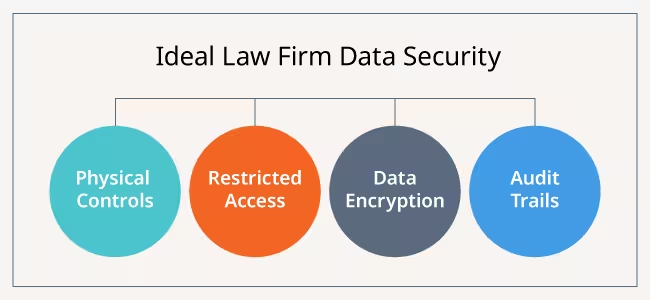
Four areas where firm leadership sets the tone
Best practices today for law firms addressing data security fall broadly into four critical areas:
- Physical and Environmental Controls
- “Need to Know” Access Within the Law Firms
- Encryption and User Authentication
- Audit trail and Access Logs
1. Physical and environmental controls
Data stored locally is only as safe as the building around it — and buildings have cleaning crews, contractors, and the occasional unlocked door. Purpose-built cloud data centers are sited away from dense areas, hardened against physical intrusion, and engineered with redundant power and cooling so that a storm or outage doesn't become a data crisis. The infrastructure question isn't just about hackers, it's about resilience.
2. Need-to-know access within law firms
Most law firm networks, left to their defaults, give everyone access to everything. It's convenient until it isn't. A more deliberate approach — restricting matter-specific data to the attorneys and staff actively working on it — isn't about distrust. It's about making sure that if one account is ever compromised, the story stops there rather than unraveling across the entire firm.
3. Encryption and authentication, end to end
Encryption in transit is the floor. Encryption at rest and in transit is where you want to be. Layer in two-factor authentication across all platforms and you've closed off most of the doors that bad actors commonly walk through. These are the same baseline requirements that financial services and healthcare organizations have operated under for years.
4. Audit trails and access logs
The major compliance frameworks — HIPAA, SOC 2, ISO 27001 — all share a common thread: detailed records of who accessed what, and when. Beyond regulatory requirements, this is simply good practice. If something ever goes wrong, the ability to trace exactly what happened — what data was touched, by whom, at what moment — is what separates a manageable incident from a much longer, costlier story.
How can law firms make sure these security protocols are in place?
The most reliable way is choosing secure software you can trust — a platform where encryption, access controls, authentication, and audit trails aren't add-ons you have to configure and monitor yourself, but built into the foundation of the product from day one. When your ediscovery and case management tools are engineered around these standards, your firm inherits that security rather than having to construct and maintain it piece by piece.
What AI adds to the firm-level conversation
AI has quietly become part of the daily rhythm at many firms, summarizing transcripts, reviewing documents, helping attorneys move faster through material that used to take days. That's genuinely exciting. It also opens up a new set of questions worth asking at the leadership level: when attorneys use AI tools to process sensitive documents, where does that data actually go? Is it being used to train external models? Who can see it?
The answer depends entirely on which tools you're using. Standardizing on platforms built with legal-specific security in mind — rather than leaving attorneys to find their own workarounds — is increasingly part of responsible firm management.
That standardization works best when it's written down. Firms should create a formal AI protocol: which tools are approved for use with client data, which are off-limits, and who to ask when a new tool comes up. Just as important is making sure every employee — from partners to paralegals to support staff — actually knows the policy and follows it consistently. A rule that lives only in the managing partner's head, or in an email nobody remembers, isn't a policy. It's a gap waiting to be found.
Nextpoint's AI transcript summaries, for example, live entirely within the platform. Deposition transcripts get distilled into narrative, chronological, or topic-organized summaries in seconds — without routing anything through external systems. It’s better to turn to trusted legal technology providers with proven security ecosystems for AI tools rather than setting client data loose in a free ChatGPT model.
See how Nextpoint keeps your firm's data secure
Encryption, matter-level access controls, audit trails, and AI features that never leave the platform — Nextpoint is built to handle the security questions above by default, not as a configuration project for your IT team.
Frequently asked questions
What are the biggest data security risks for law firms in 2026? Law firms face threats from multiple directions: external hackers targeting confidential client data, social engineering attacks designed to exploit human trust, phishing schemes that have grown far more convincing, and newer risks introduced by AI tools that may not be built with legal confidentiality in mind. On-premise storage connected to the internet also carries more risk than many firms realize, particularly when compared to purpose-built, encrypted cloud environments.
Is cloud storage actually safer than on-premise storage for law firms? For most firms, yes — and by a meaningful margin. Dedicated cloud data centers are engineered specifically around security, with physical access controls, redundant infrastructure, and full-time security teams that the average law firm can't reasonably replicate. The common concern that cloud storage is more exposed to hackers tends to overlook the fact that any on-premise server connected to the internet faces the same exposure, often with far fewer resources protecting it.
How should law firms think about AI and data security? AI is increasingly valuable for legal work — document summarization, transcript review, and research are all areas where it genuinely saves time. The security question is: where does the data go when you use it? General-purpose AI tools may use your inputs for model training or route data through external systems. Legal teams are better served by AI features built into platforms that already protect their data, where confidentiality is part of the architecture, not an afterthought.
What is two-factor authentication and why should law firms require it? Two-factor authentication (2FA) adds a second verification step beyond a password — typically a temporary code sent to your phone or email — before granting access to an account. Even if a password is stolen or guessed, 2FA prevents an unauthorized user from getting in. For law firms, requiring 2FA across all platforms is one of the most straightforward and effective security measures available, and increasingly an expectation under major compliance frameworks.
What should law firms look for in a secure ediscovery platform? Look for encryption of data both at rest and in transit, two-factor authentication, granular access controls that restrict data by matter, detailed audit logs that track who accessed what and when, and a clear data governance policy that explains how your information is stored and whether it's ever used for external purposes. Cloud-native platforms purpose-built for legal work — like Nextpoint — are designed with these requirements as foundational, not optional.
How does Nextpoint protect client data? Nextpoint is a cloud-native platform built from the ground up with legal security requirements in mind. It offers encryption at rest and in transit, two-factor authentication, matter-level access controls, and detailed audit trails. Its AI features — including AI Transcript Summaries — operate entirely within the platform, so sensitive client data is never routed through external systems. Nextpoint also maintains compliance with major security frameworks to give firms confidence that their data is protected to the highest standards.
Join our Nextpoint newsletter list
Related Resources
Blog

Blog
eDiscovery and information governance are more connected than you think. Here's what the EDRM 2.0 project is changing.

Blog

Blog
How Nextpoint's case building tools connect with OnCue to take evidence from deposition designation to courtroom presentation.
Blog

Blog
This ediscovery checklist covers each step you need to complete to protect attorney-client privilege and navigate clawbacks with confidence.
Experience Nextpoint for yourself
Learn how our transparent pricing and powerful platform help legal teams streamline litigation from discovery to decision.