

EDRM 2.0 is here: What changed, why it changed, and what it means for your practice
A conversation with Mary Mack and Holley Robinson of EDRM


For two decades, the Electronic Discovery Reference Model has been the closest thing our industry has to a shared vocabulary. It's the diagram on the first slide of every ediscovery 101 deck, the one that taught a generation of litigators the difference between preservation and collection. It has also, for most of that time, stayed put.
That changed this month. EDRM released EDRM 2.0, the first substantive update to the model since it absorbed the Information Governance Reference Model. The new version is the product of roughly 150 practitioners working across two years, and it reflects a discovery practice that looks meaningfully different from the one the original model described in 2005.
We sat down with Mary Mack, CEO and Chief Legal Technologist at EDRM, and Holley Robinson, Marketing Operations Director at EDRM, to talk through what's new, what got debated, and what legal teams should actually do with it.
This conversation has been edited and condensed for clarity.
EDRM 2.0 at a glance
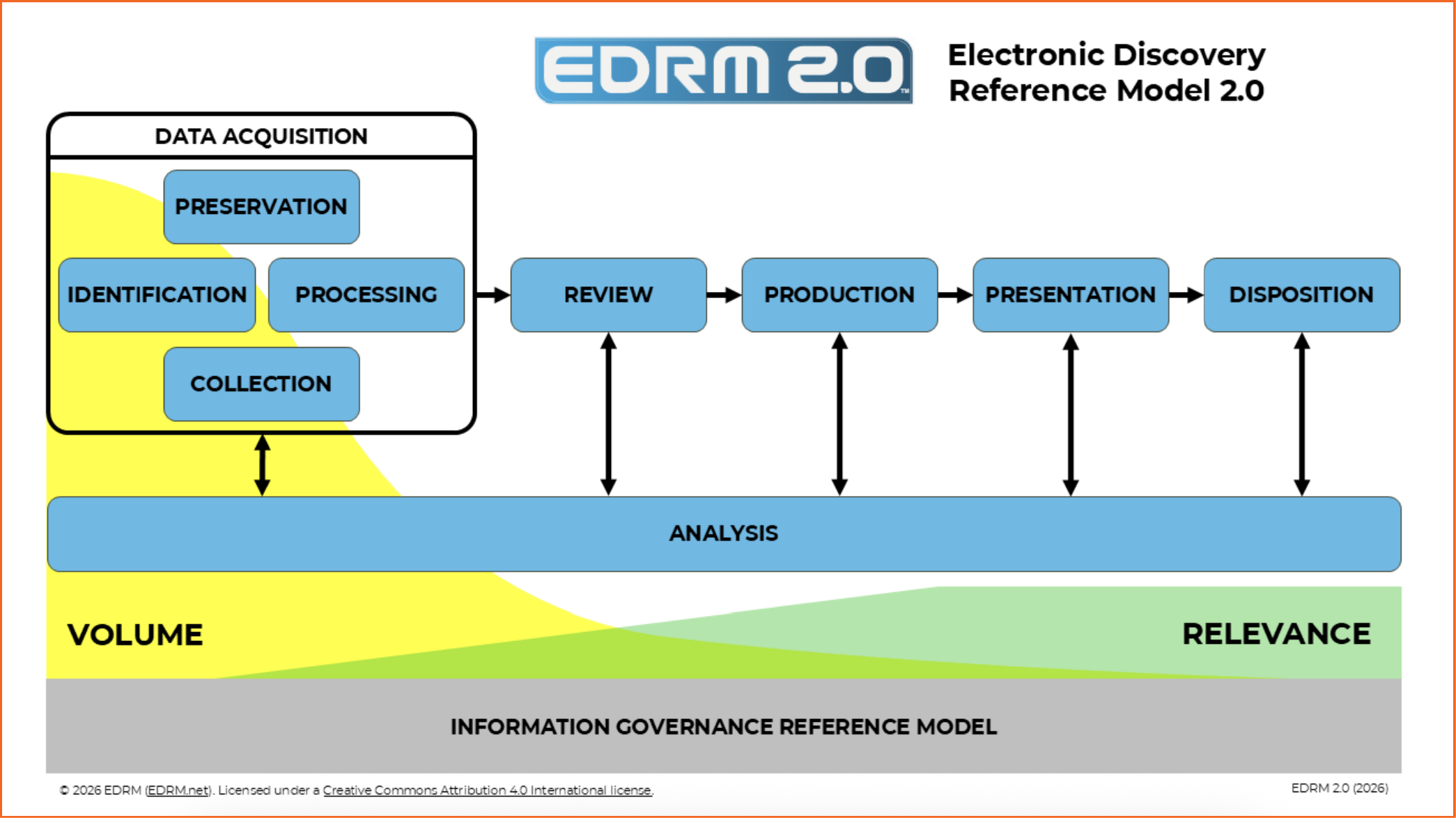
- Data acquisition is now a unified framework. Identification, preservation, collection, and processing are grouped rather than strictly sequential.
- Information governance became foundational. IGRM runs underneath the entire model instead of sitting off to the side.
- Analysis runs continuously. It’s the intelligence and AI layer feeding every phase, not one box in the middle.
- Disposition is a discrete phase. Legal teams now have an explicit prompt to deal with data once a matter closes.
What's new in EDRM 2.0?
There are four main changes, according to Mary, and they work together more than they might appear at first glance.
Data acquisition is now a unified framework. Identification, preservation, collection, and processing are grouped together rather than presented as strictly sequential steps. This accommodates how the work actually happens now, particularly inside corporate legal departments, where teams increasingly work with data in place and don't need to collect right away. The tooling caught up to the workflow, and the model caught up to both.
Information governance became foundational. In prior versions, IGRM sat upstream, off to the side of the discovery lifecycle. In 2.0, it runs underneath the entire model as a foundational layer. The point is that governance principles should be adhered to while the discovery process is happening, not consulted once at the beginning and then forgotten.
Analysis runs continuously across every stage. Mary described analysis as the connective tissue of the new model — the intelligence and AI layer feeding into every single phase rather than occupying one box in the middle of the diagram.
Disposition is now a discrete phase. This is the addition drawing the most attention, and the one with the most immediate practical consequences. More on it below.
The team also worked to make the model more accessible generally, which matters more than it sounds. This diagram is how most people first encounter ediscovery.
How did you decide on these changes?
The changes came out of a chartered consensus project with trustees recruited to cover perspectives the old model underweighted.
Mary Mack: This was a passion project, and it was a passion project for the late Kaylee Walstad as well. We heard from the very beginning when we acquired the EDRM that it was out of date and needed changes. And until there were very serious people who wanted to champion a project — that's how all of our EDRM consensus projects get chartered.
So we chartered the team. We had trustees from the left, middle and right. Brett Burney (formerly at Nextpoint) was one of those trustees, and they did a deep dive to see if things had changed in those particular areas. Dave Cohen, our chair of the project trustees, provided a lot of guidance and oversight.
Then we made a public call. People raised their hand, and we looked at the composition of the group to make sure we had things that had been identified as missing before.
One was a global perspective. Their ediscovery is edisclosure, and the international version is much narrower, working under different constraints. We wanted to make sure that view was present. We also wanted to make sure the receiving parties and requesting parties were well represented, because we heard pretty loudly and clearly that the model was weighted towards producing parties. So we had active outreach to plaintiff-oriented firms. One of our trustees, Stephanie Clerkin, hails from the plaintiffs side.
What did the process of reaching consensus actually look like?
The process included live global calls, structured voting with written rationale, and a very high bar for agreement.
Mary Mack: The first question was whether the EDRM needed changing at all, and there was active disagreement on that. Some said keep it the same. Others said no, we need to change it.
We used Zoom as the mechanism. Sometimes we'd have 100 people from around the globe on a live call, and they were able to speak. The ethic that developed was wonderful, because the communication stayed respectful even though people felt very passionately — if you can believe it, very passionately — about elements of the EDRM.
To drive consensus, they'd take discrete elements of whatever was under discussion that had contention and vote using the Menti app. They'd send an email beforehand saying here's what we're voting on, so people could look at it in advance. And they didn't just vote. They added text explaining why they were a no vote, or why they were an enthusiastic yes. So we captured both quantity and quality.
We didn't do majority rules. We didn't even do supermajority rules. It was like super, super majority, because we're talking about consensus. We didn't drive to 100% consensus, because my God, we'd still be there on the first question. But you know it when you see it.
Holley Robinson: We had the trustee meetings and the committee member meetings, and towards the end we brought it to the larger Global Advisory Council so everyone in the larger group could comment.
Earlier this year at Legalweek, when they had a rough draft of the 2.0 model, we brought it in poster board form with a "share your thoughts" prompt and smiley face, frowny face, and neutral face stickers so people could visually share what they wanted. That was open to everyone at Legalweek, whether they knew about EDRM or not. We were able to talk with them in person and hear their likes and dislikes.
Mary Mack: That listening we did at Legalweek was really helpful. And we recorded everything in longhand.
Holley Robinson: Lots of notes.
Mary Mack: Very high tech.
About 150 people were involved over the two-year period. Not 150 at one time on a Zoom, but sometimes we were over 100.
Why did disposition earn a place on the model?
Disposition has always been an element of information governance, but it isn't standard practice everywhere, and it certainly hasn't been treated as part of the discovery lifecycle. EDRM 2.0 makes it explicit: there's a practical, legal, and ethical responsibility to deal with data once a matter concludes.
There's also an opportunity argument, and it's the one legal teams should be paying attention to right now. At the end of an ediscovery matter, you're sitting on data that has been classified with human oversight and carries a documented chain of custody. As Mary put it, most AI systems don't record provenance when they ingest documents. Reviewed, coded ediscovery data does. That makes it a genuinely unusual asset in an era when everyone is trying to figure out what to feed a model.
How do you implement the disposition phase in practice?
Start with an inventory, account for every copy, set the policy before you need it, and document where the data goes.
Mary was careful to frame this next part as her own view rather than the committee's: "Mary Mack as a thought leader, not Mary Mack as consensus work product, EDRM official kind of thing." With that caveat, here's her advice.
- Start with an inventory. Know what client data you hold, who owns it, who supplied it, and under what conditions. Some clients are far more sophisticated in this area than others, and you may already have information governance and disposition instructions you're obligated to follow. In the absence of any instruction, build the inventory yourself.
- Account for every copy, not just the original. Most of us don't work off originals, we work off copies. Mary walked through what she calls the exploding megabyte: you have the original PSTs, then the PSTs explode into individual messages, then the zips and unzipped files, then the embeds. You have indices. You have the review calls that were made. You may have processed data in one place and promoted data in another. And you have the productions themselves, both redacted and unredacted.
- Decide the policy before you need it. Develop internally how you want to treat this with your client, and understand how your client expects you to treat it. Make it part of case closeout rather than something you improvise eighteen months later.
- Don't assume the answer is deletion. For what Mary calls frequent flyers — companies in serial litigation — that data often gets reused for good-faith productions in future matters. You may not want to erase it. You may want to promote it or reclassify it. Her rule of thumb: the fewer moves the better.
- Document where it goes. If the client does want destruction, that can mean removing it from cloud storage and tearing down containers, and it can also mean returning physical media or obtaining a certificate of destruction for it. Vendors exist that provide exactly this.
Were there changes you considered that didn't make the cut?
Changes considered include early case assessment as a standalone stage, several data acquisition layouts, and a front-and-center spot for information governance.
Mary Mack: Early case assessment (or early data assessment) as a separate stage was discussed, and it didn't make it.
Holley Robinson: There was a lot of discussion on the data acquisition box, the ordering, how it should be presented, which direction people are going to read it. A lot of that didn't make it through to the final model.
Mary Mack: There was also debate on whether processing is a totally separate phase. That would be the case when data has to move somewhere else and separate tools are used on it. But processing is also going on inside corporate entities just to be able to search, so could it live in that box?
And during the public comment period and the trustee meetings, there was a lot of discussion on whether the information governance model should still be at the front. And if it was at the front, should it be a flat stage like it was ten years ago, when it was called information management and looked like a regular phase? Or does the whole circle need to be at the front? The compromise was to make it foundational, so it's more than just the front. It's all the way through.
Holley Robinson: The IGRM positioning was one of the main things we got comments on at Legalweek too. Some people said, oh, I didn't even notice it down there, or it should be at the top. But I think the way they presented it is definitely visible and represents the baseline well.
What should legal professionals take away from the new model?
The model is built for an AI-shaped practice, and you’re free to use it.
Mary Mack: It's primed for the future, certainly with the AI upon us, and so the analysis. Everybody's rolling their own and figuring out how to do this themselves. It's all incorporated in there.
A reminder on our licensing: it's Creative Commons Attribution 4.0 International, which allows commercial use without permission from us and without payment. There's an attribution requirement and some labeling. The diagram can be used as is, or you can take off our headings, put your own logo on it, say "modified from the original," and attribute back. That's all fine. We encourage its use.
We're really excited to see what the community does, and how we educate ourselves for this very critical two-year period as AI gets into everything. Practices are changing rapidly. Best practices are changing. I don't even know if you can call them best practices, because the court decisions are just beginning.
Frequently asked questions about EDRM 2.0
What is EDRM 2.0?
EDRM 2.0 is the updated Electronic Discovery Reference Model, released September 1, 2026. It's the first substantive update since EDRM absorbed the Information Governance Reference Model, and about 150 practitioners contributed over two years. It reorganizes data acquisition, makes information governance foundational, runs analysis continuously, and adds disposition as a distinct phase.
What are the four main changes in EDRM 2.0?
Data acquisition became a unified framework covering identification, preservation, collection, and processing. Information governance moved from a side element to a foundational layer beneath the whole lifecycle. Analysis now runs continuously across every stage instead of sitting in one box. And disposition joined the model as its own phase.
What is the disposition phase in EDRM 2.0?
Disposition covers what happens to data after a matter concludes. EDRM 2.0 treats it as a practical, legal, and ethical responsibility rather than an afterthought. In practice it means inventorying the client data you hold, accounting for every copy, agreeing on policy with your client in advance, and documenting where the data ultimately goes.
Does disposition always mean deleting the data?
No. For companies in serial litigation, reviewed and coded data often gets reused for good-faith productions in later matters, so promoting or reclassifying it may serve the client better than destruction. When a client does want destruction, that can mean tearing down cloud containers, returning physical media, or obtaining a certificate of destruction.
Can I use the EDRM 2.0 diagram in my own materials?
Yes. The diagram is licensed under Creative Commons Attribution 4.0 International, which permits commercial use with no permission or payment required. You need to attribute EDRM.net, and if you modify the diagram — swapping headings or adding your logo — you need to indicate that it's been modified from the original.
What didn't make it into EDRM 2.0?
Early case assessment as a separate stage was discussed and cut. Several alternative layouts for the data acquisition box were debated and dropped. Contributors also considered whether processing should stand alone as its own phase, and whether information governance should sit at the front of the model rather than underneath it.
Put the new model to work
The disposition phase only works if you know what data you're holding and where every copy lives. Nextpoint keeps your evidence, review decisions, and productions in one cloud-native platform from discovery to decision, so case closeout starts with a clear inventory instead of a scavenger hunt. And with predictable per-user pricing — no processing fees, no hosting fees, no per-matter fees — keeping data available for the next matter doesn't cost you a surprise invoice.
Join our Nextpoint newsletter list
Related Resources
Blog
Blog
How Nextpoint's case building tools connect with OnCue to take evidence from deposition designation to courtroom presentation.

Blog

Blog
eDiscovery and information governance are more connected than you think. Here's what the EDRM 2.0 project is changing.
Blog

Blog
This ediscovery checklist covers each step you need to complete to protect attorney-client privilege and navigate clawbacks with confidence.
Experience Nextpoint for yourself
Learn how our transparent pricing and powerful platform help legal teams streamline litigation from discovery to decision.